
PHILOSOPHY
Weaving memory, shaping the future.
We think of buildings as things that exist in time.
Architecture carries the traces of what has been cultivated over long periods: the ways people live, their history, culture and craft. Design, for us, therefore begins by reading what is already there and carrying it forward into the next chapter.
Whether we are designing something new or bringing an old building back to life, we are never looking at the building alone. We ask what kind of life has unfolded there, what kind of landscape surrounds it, and what layers of time have accumulated within it.
Architecture is neither about preserving the past exactly as it was, nor about replacing everything with the new. It is about finding what lies in between — deciding what to keep, what to change, and what to add.
Old buildings possess qualities that only time can produce: weathered materials, structure, spatial arrangement, the shifting play of light, the surrounding streetscape. At the same time, adapting them to contemporary life means upgrading insulation, seismic performance, building services and everyday usability.
Materials, too, carry time forward. We reuse the original fittings and timber wherever possible, and choose new materials that will gain depth and character as the years pass. We see ageing not as deterioration, but as the process by which a space gathers its memories.
Memories will also be made in the future — time spent as a family, time spent gathering together, time spent becoming part of the townscape.
Every new building will one day become part of someone’s memory. That is why we want to create architecture that holds its value not only today, but long after.
To reweave what we have inherited from the past, and to shape the time that lies ahead.
PRACTICE
1. Starting from the potential of the site and the building
Land prices, building condition, regulatory constraints and construction costs may seem like separate issues, but in reality they are all connected.
From the very first stage of choosing a site or property, we bring real estate, architecture and building regulation to the same table. We assess a property with the eye of a licensed real estate professional, and estimate what the building work will realistically cost with the eye of an architect. Regulatory questions — such as change of use or existing non-conforming status under Japanese building law — are also reviewed at this stage.
How much of the total budget goes into the land, and how much remains for the building? That balance ultimately determines what kind of life or business can be realised there.
2. A new everyday, shaped through dialogue
Architecture is not made by the architect alone.
What we value most is dialogue with our clients. Not only what you want to build, but how you want to live, work or use the building — together we explore what works today, what needs to change, and what possibilities the project could open up.
Using 3D models (BIM), we visualise the space and run simulations of daylight and thermal comfort, so that ideas can be shared clearly.
What is hard to grasp from drawings alone, we look at, talk through and confirm together.
From finding a site to designing bespoke furniture and considering how light falls on a windowsill, we give form, through ongoing conversation, to the particular way each client wants to live, work or use a place.
3. Uniting performance and the senses
A comfortable space is supported by elements that cannot be seen.
Drawing on Swiss and German standards, we achieve high levels of insulation and airtightness to create a stable thermal environment, and combine this with seismic reinforcement based on structural calculations — ensuring comfort and safety backed by measurable performance.
Yet the comfort of a space is also shaped by materials you can touch and see.
The feel of timber, the texture of plaster walls, the way a surface changes as it catches the light.
Neither performance alone nor design alone. We carefully consider every material and value a comfort that can be felt with all five senses.
PROFILE
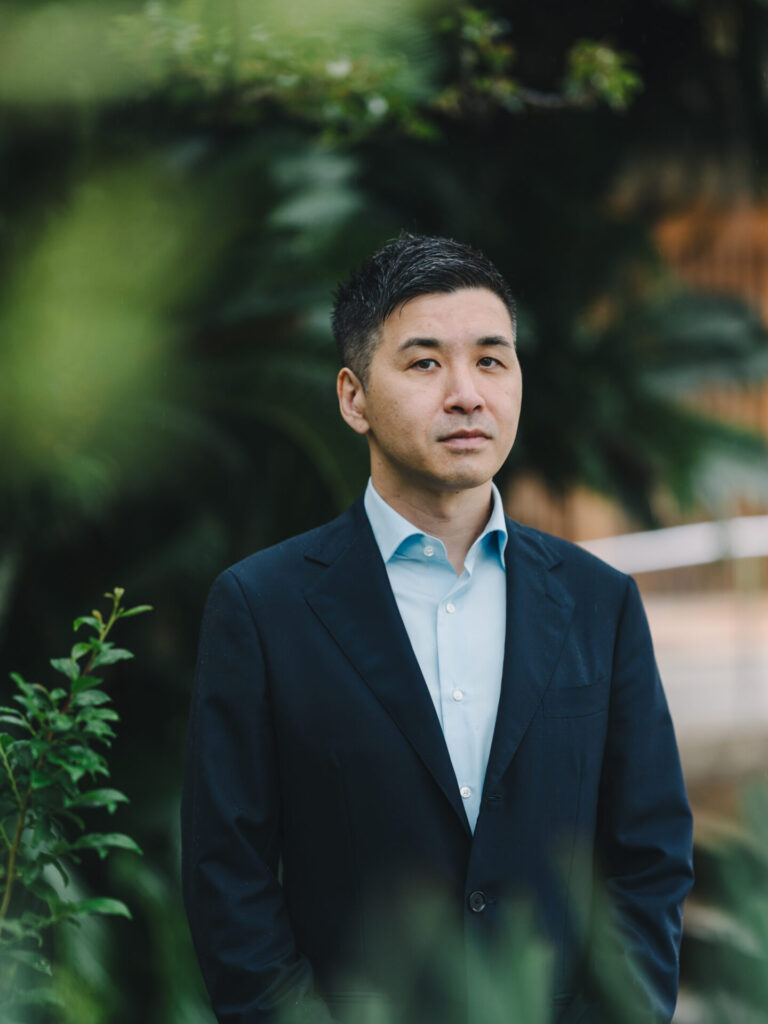
Masashi Takeda
Principal of raumus. His work ranges from new houses to the regeneration of existing buildings, combining refined design with high building performance. His approach integrates practical experience in Europe — where continuing to use buildings rather than demolishing them is the norm — with a deep understanding of Japanese architectural culture.raumus
Licensed First-Class Architect, Japan (No.388907)
Licensed Real Estate Transaction Specialist, Japan (No.21400899)
Certified Inspector for Existing Housing Condition Surveys, Japan (No.0223910335)
Registered Architect, Architektenkammer Nordrhein-Westfalen, Germany (No. 107152)
Born in 1982 and raised in Osaka. After studying at Setsunan University and Tokyo Institute of Technology, he worked at Atelier and I Kazunari Sakamoto Architectural Laboratory until 2014. He then moved to Europe, where he worked for Heide & von Beckerath (Berlin) and Ingenhoven Architects (Düsseldorf) in Germany, and Schneider & Schneider (Aarau) in Switzerland. His experience in Europe — where old buildings are routinely kept and passed on from one generation to the next — continues to shape his approach to design today. He returned to Japan in 2019 and founded raumus in Fukuoka.
2019-2023年 Part-time Lecturer, Aso College of Architecture & Design
2024年 – Part-time Lecturer, Kyushu Sangyo University
2026年 – Part-time Lecturer, Kyushu Women’s University
| 2025年 | 2th Saichiku Award (Rebuilding Award) Grand Prize, Minister of Land, Infrastructure, Transport and Tourism Award (Renka) |
| Good Design Award 2025 (Renka) | |
| 2023年 | WOODONE Space Design Award 2023 Award of Excellence (Tsuchida Minka) |
| 2022年 | Good Design Award 2022 (Tsuchida Minka) |
| 2021年 | 25th Energia Housing Contest Grand Prize, Renovation Category (Tsuchida Minka) |
| 2018年 | AIJ Selected Architectural Designs 2018 “Sanda House Renovation” |
| 2017年 | AIJ Annual Architectural Design Commendation 2017 “Hut AO” |
| 2008年 | 1st Asahi Global Student Design Competition — First Prize |
| 2007年 | 2nd All-Japan Student Design Competition for Environmentally Symbiotic Housing First Prize |
OFFICE
raumus
The name combines the German words Raum (space) and Muster (pattern, design).
Location
Fukuoka, Japan
Registration
First-Class Architect Office, registered with the Governor of Fukuoka Prefecture (No. 2-61002) Full Member, Fukuoka Association of Architects & Building Engineers Covered by Architects’ Professional Liability Insurance
Services
・Planning, design and construction supervision for architecture and interiors
・Change-of-use applications and building code compliance surveys for existing buildings
・Surveys, utilisation advice and regeneration planning for pre-owned and vacant properties
・Design of furniture, products and graphics
・Related consulting services
Area of Work
Based in Fukuoka and working across Japan, we take on projects ranging from new buildings to the adaptive reuse of complex existing buildings. We also work with international clients and property owners seeking architectural support in Japan. For clients at a distance, we combine online meetings with on-site visits. For enquiries, please get in touch via our contact page.
